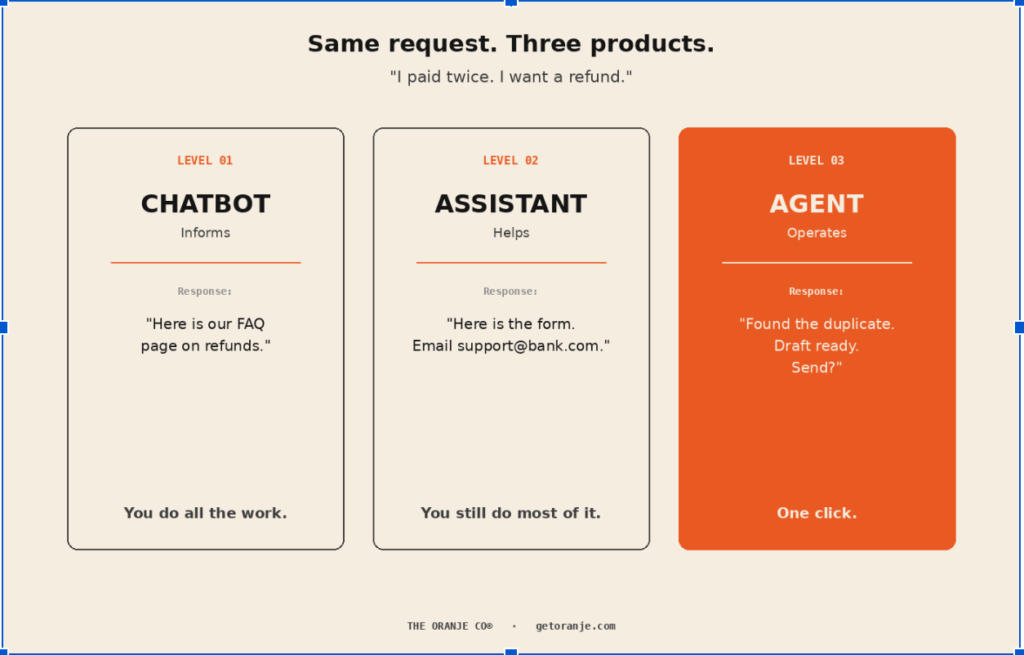
The chatbot informs. The assistant helps. The agent operates. Same user. Three completely different products.
You paid for something twice. You want a refund.
Watch what three different products do with the exact same request.
Product 1. A chatbot. “Here is our FAQ page on refunds.” You leave the chat. You read the FAQ. You start filling something out.
Product 2. An AI assistant. “Here is the refund request form. Fill it out and email it to [email protected].” Better. You are still doing all the work.
Product 3. An AI agent. “I found the duplicate transaction on 15 July for ₹4,999. I have drafted the refund request with the reference number, transaction details, and account info. Do you want to send it?”
That third product is Agentic UX. And the gap between it and the other two is where product design is quietly getting rebuilt.
The shift
Product designers have been trained on one paradigm. The user does the work. The product provides the tools.
Agentic UX inverts that.
The user brings intent. The agent brings execution. The user approves.
Same three-line summary in industry language, from Dr Carmen Martinez’s Agentic Experience Design guide:
- Chatbot UX = Informer / Responder
- Agentic UX = Operator / Doer
- Chatbot UX = writing scripts and conversational flows
- Agentic UX = designing behaviors, policies, and safeguards
That is not a small change. It is a fundamentally different design discipline.
Why this matters now
Gartner expects 40% of enterprise apps to embed task-specific AI agents by the end of 2026, up from under 5% in 2025.
Studies of banks that shipped AI as simple chatbots showed 20 to 30% lower task completion rates than banks that shipped agentic implementations. Same users. Same problem. Different design paradigm.
Users are already calibrating to the third experience. Whether or not your product has caught up.
What good Agentic UX actually looks like
Four things separate a real agent from a dressed-up chatbot.
It reads context, both ways. The agent knows your transaction history, calendar, previous conversations, active tickets. And what it does flows back to the user in the place they are already working.
It proposes actions, not information. Not “here is the form.” Not “here is what to do.” A pre-filled draft that only needs approval.
It respects a gradient of consent. Low-risk actions can happen automatically. High-stakes actions like sending, paying, deleting, pause for confirmation. Consent granularity is now a core design decision.
It fails recoverably. Every action has an undo. Every decision has a trail. When the agent gets it wrong (and it will), the user is one click from correcting it.
Miss any of these four and you are shipping a chatbot with a shinier label.
What most teams still get wrong
Alexandra Vasquez, writing on Agentic UX principles, names the most common failure directly. Teams treat the agent as a separate space. Sidebar chatbots. “Try AI!” banners. Slide-out panels.
Users bounce between the agent and the actual work. The experience feels disjointed. Adoption dies
Agents do not need their own screen. They need better systems to operate in.
The best implementations are almost invisible. The agent shows up inline, in the flow where the work is already happening, at the moment context is thickest.
Closing thought
The bar has moved.
Users used to accept “here is the information you need to complete the task.”
The new bar is “here is the task, drafted, ready for your approval.”
If your product still ships the first version, you are competing against the third. Users are not going to explain the difference. They are just going to leave
Build for the third.
Further reading
Designing for AI Agents: 10 UX Patterns 2026. Specific patterns shipping in production right now.
What is Agentic Experience Design? A Beginner’s Guide. The cleanest definitional breakdown of chatbot vs agent UX.
Agentic UX: 7 principles for designing systems with agents. Practitioner walkthrough with real failure modes.