Last year, I met Priya. She was a fresh graphic designer wanting to learn UX design. She found a course on Udemy for ₹499. Excited, she enrolled.
Two weeks in, she realized the course was just someone screen-recording their Figma work while mumbling instructions. No structure. No real teaching. Just pixels moving around.
She felt cheated. Not because she lost ₹499 (though that hurt). But because she wasted two weeks thinking she was learning something.
Turns out, 67% of online UX course students feel the same way. They buy cheap courses expecting education. They get marketing instead.
The question isn’t “how cheap can I go?” The real question is “how do I spot a quality UX course that won’t waste my time?”
The Problem With Most Cheap UX Courses
Affordable UX courses exist everywhere. Udemy, Coursera, Skillshare. Prices ranging from ₹300 to ₹3,000. But cheap doesn’t mean good.
Here’s what usually happens with budget UX courses:
They’re recorded once and reused forever. The instructor never updates content. Industry changes. Design trends shift. Your course stays stuck in 2019.
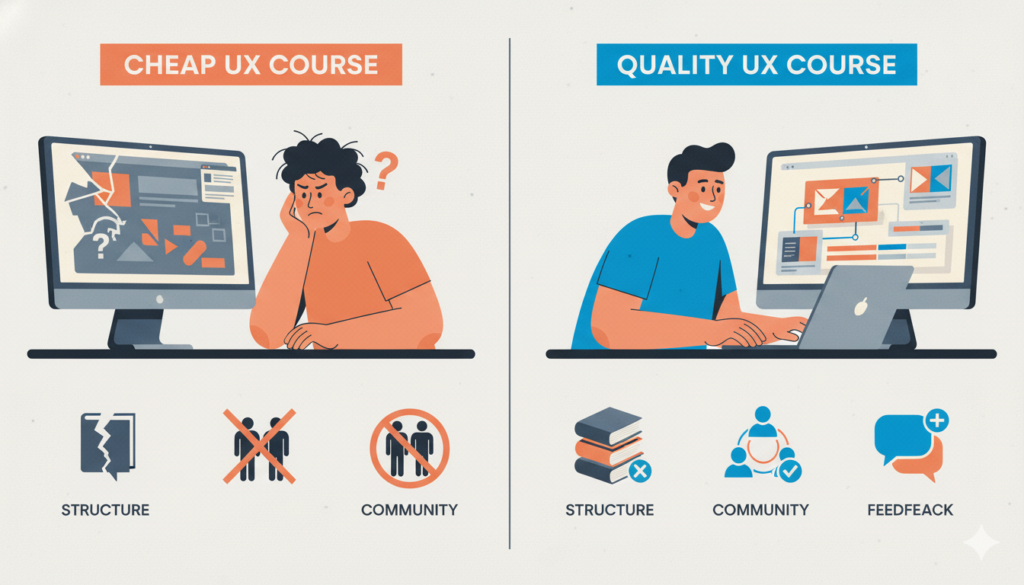
They lack structure. Videos jump between topics randomly. You finish the course without understanding the bigger picture.
No feedback. You build projects. Nobody reviews them. You don’t know if your work is actually good.
Generic content. “Learn Figma basics.” “5 color theory tips.” Nothing specific to real-world problems.
No community. You’re alone. Nobody to ask questions. Nobody to learn from.
This is why 73% of people who start cheap UX courses never finish them.
What Actually Makes a Quality UX Course
Real UX courses have specific characteristics.
They have clear structure. Week 1: foundations. Week 2: research. Week 3: wireframing. Week 4: visual design. You understand the journey.
They teach through real problems. Not “5 design tips.” Instead: “Build a mobile banking app from scratch while making it accessible.”
The instructor is active. They answer questions. They update content when industry changes. They care about student success.
There’s community. Discord channels. Discussion forums. Other students learning alongside you. This matters more than fancy videos.
You get feedback. Peer review. Instructor review. Real critique on your work. This is what builds skills.
The course has a completion rate above 35%. If 90% of people quit, that’s a red flag. If 50%+ complete it, something’s working.
Where to Find Quality UX Courses (Without Spending ₹50,000)
Interaction Design Foundation (IDF)
- Cost: Free to ₹3,000 depending on level
- Why: Founded by actual UX researchers. Content is research-backed. Not guessing.
- Best For: Foundational UX knowledge. User research. Design thinking.
- Completion Rate: 45% (good sign)
- Indian Advantage: Offers Indian pricing, has Indian students
Coursera (Specific Courses Only)
- Cost: ₹0-₹2,000 per course (audit free, certificate costs ₹500-₹2,000)
- Why: University-backed. Real instructors. Structured properly.
- Best For: Academic foundation. Principles before tools.
- Look For: Courses from Nielsen Norman Group or Michigan University
- Avoid: Random “UX for beginners” courses
Career Foundry
- Cost: ₹50,000-₹90,000 (expensive but worth it if budget allows)
- Why: Mentor-led. Real feedback. Job guarantee.
- Best For: Career switchers. Want guaranteed employment.
- Skip If: You just want to learn casually
LinkedIn Learning (Free Trial)
- Cost: ₹500/month or free with LinkedIn Premium
- Why: Consistent quality. Short videos. Easy to follow.
- Best For: Specific skills. “How to use Figma.” “Design systems basics.”
- Not For: Complete UX education. Good for supplementary learning.
YouTube Channels (100% Free)
- AJ&Smart: Design thinking, design sprints
- Figma: Official tutorials
- Nielsen Norman Group: UX research fundamentals
- Adob XD: Design tools (though outdated now)
- Cost: Free
- Best For: Supplementary learning. Not primary education.
The Smart Way to Learn UX Without Spending Big
Here’s what actually works:
Start free. Pick one free resource. Complete it fully. Don’t jump around.
Then invest slightly. Spend ₹2,000-₹5,000 on one structured course. Pick one that has community.
Learn by building. The course should require you to build real projects. Not watch. Build.
Get feedback. Join communities. Post your work. Ask for critique. This is where real learning happens.
Keep going. One ₹5,000 course is better than five ₹499 courses that you abandon.
The Reality Check
Good UX education doesn’t have to be expensive. But the cheapest option usually isn’t good.
Think of it like this: A ₹500 course that you quit after two weeks costs you wasted time + ₹500 + lost opportunity.
A ₹5,000 course that teaches you real skills pays for itself with your first freelance project.
The question isn’t “what’s the cheapest?” It’s “what will actually teach me something valuable?”
Priya eventually found a structured ₹4,500 course with real feedback. Finished it. Built a portfolio. Got a junior design job within 6 months.
She didn’t save money. She made money. Because she invested in quality.
Remember Priya who wasted ₹499 on a terrible course? She later told me something funny: “That bad course actually taught me something—how to spot bad courses.”
She now spends ₹300-₹500 monthly on learning, but only after vetting the course for structure, community, and feedback quality. No more gambling on budget courses.
The moral? In UX course hunting, you’re not looking for the cheapest option. You’re looking for the option that respects your time and teaches you real things.
Priya’s advice: “Pay for quality, not quantity. One good course beats five bad ones every time.”