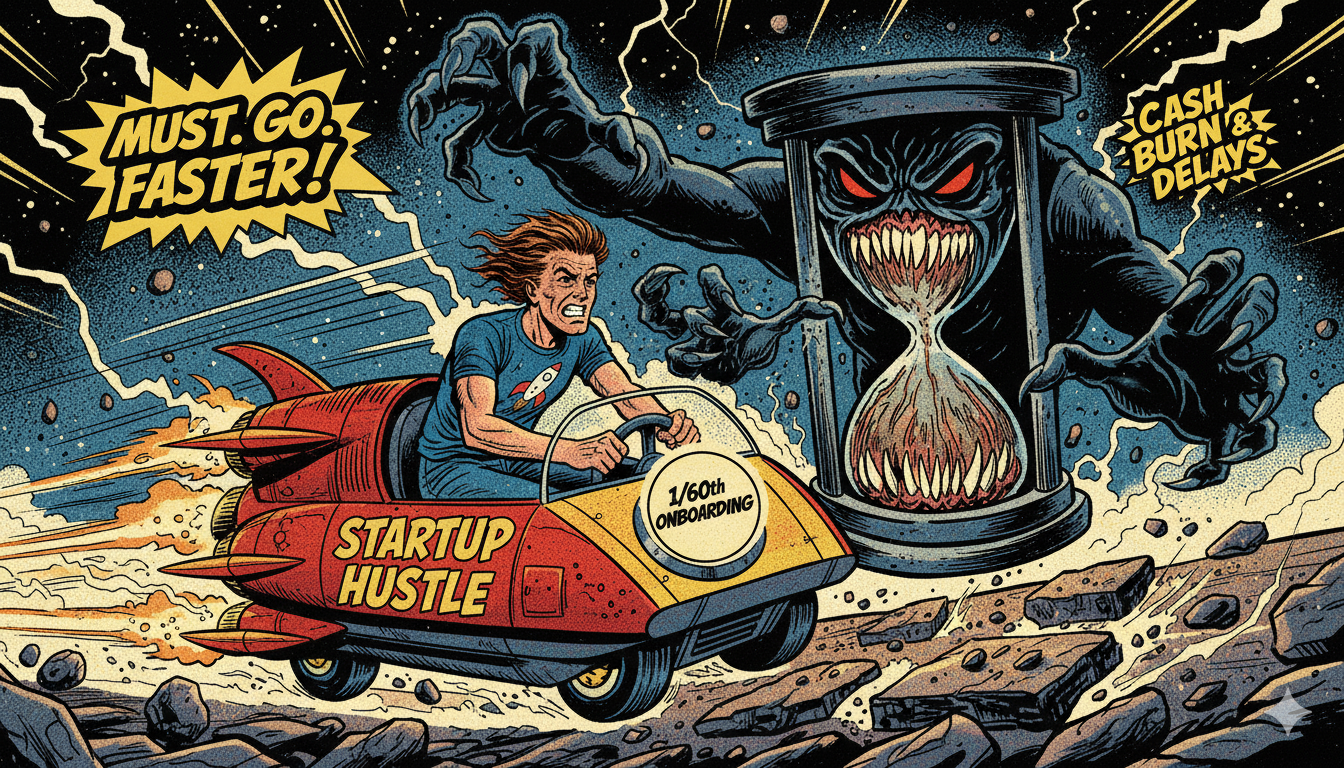
Speed is survival.
Startups don’t have patience for slow systems. They move fast because they have to and every day without traction is a day closer to their cash runway drying up. This is why 1/60th onboarding time fits their reality perfectly. When you can condense what traditionally takes days or weeks into a fraction of that time, you’re speaking the language of founders who measure success in pivots, not presentations. Research shows that within the first 90 days of a client relationship, trust either builds or erodes completely and for startups operating on tight timelines, this compressed onboarding period is where momentum gets established.
Startups Value Speed Over Perfection
Founders want momentum. They want visible movement. Long onboarding feels like friction, a necessary evil that delays their ability to test assumptions and gather market feedback. The psychological weight of waiting extends beyond just time; it creates doubt. If an agency takes three weeks to get started, what message does that send? That they’re overwhelmed. That they’re not aligned with startup culture. That they might not move fast when problems arise.
Question: “How quickly can you typically start working on our project?”
Answer: “We’re built for startup velocity. Most projects move from signed contract to tangible work within 48 hours. We use guided intake forms instead of endless discovery meetings, meaning we ask the right questions once, in a structured format, and move forward. This isn’t rushing, it’s respecting that your runway is finite and your window of opportunity isn’t negotiable.“
Agencies that onboard quickly feel aligned with startup culture. Those that don’t feel risky. In a study by research firm Bain & Company, customers are four times more likely to switch if the problem is service-related rather than price or product-related. This means your onboarding isn’t just about logistics—it’s about demonstrating you understand the startup ecosystem.
Faster Onboarding Means Faster Validation
When projects start immediately, startups can test ideas sooner. Landing pages go live faster. Ad campaigns launch on schedule. Customer feedback comes in before assumptions harden into certainty. That speed can be the difference between pivoting early (while capital and founder energy remain high) or failing late (when options have narrowed).
The metric that matters most to startups is Time to Value (TTV)—how long until they see tangible results. Research on customer onboarding shows that reducing TTV directly correlates with satisfaction, retention, and the likelihood of contract renewal. For a startup, TTV isn’t just a metric; it’s existential. If you can cut their path to first meaningful result in half, you’re not just improving efficiency—you’re extending their viability window.
Question: “What can we realistically expect to see in the first month?”
Answer: “By week one, you’ll have your first deliverable—whether that’s a wireframe, campaign draft, or strategy document. By week two, we move into revision cycles based on real feedback, not theoretical improvements. By month’s end, you have something launch-ready. This isn’t a prototype or a concept; it’s a foundation for real market testing. We see startups use these early wins to inform their next sprint of development or to generate the social proof they need for their next funding conversation.“
Trust Is Built Through Action
Startups judge partners by execution, not promises. A beautifully designed proposal doesn’t matter if the partner takes two months to deliver on it. 1/60th onboarding time proves you can act decisively. That’s currency in early-stage business. When a startup founder sees that you’ve collected the information they need, synthesized it, and produced meaningful output within 48 hours, something shifts. Trust moves from theoretical to concrete. They’ve seen proof, not potential.
This ties directly to research on early wins in organizational change. Securing visible momentum in the first 90 days builds psychological momentum that carries teams forward. For a startup, this isn’t about bells and whistles—it’s about proof that the partnership is worth their limited attention and capital.
Why Startups Stick Around
Agencies that respect speed often become long-term partners. Startups grow, budgets increase, and the relationship deepens. But the foundation for that long-term relationship is set in those first two weeks. A startup that experiences quick onboarding begins their relationship with your agency already in motion. They don’t start thinking “will this work?” They start thinking “how do we scale this?”
Question: “What happens after the initial onboarding phase?”
Answer: “Onboarding creates the ramp. The real relationship is built on what happens next—responsiveness, quality, and continued alignment. Startups we work with often extend engagements because we’ve proven we can move at their speed without sacrificing quality. We’ve also built systems where communication stays efficient; there’s no administrative bloat. Every touchpoint is intentional. As you grow, we scale with you, but the operational principles stay the same.“
Fast onboarding isn’t a shortcut. It’s a signal that you understand how startups survive and how their decision-making works. It tells them you’ve optimized for their reality, not for a generic client journey. In a market where trust is built over weeks rather than months, that signal carries enormous weight.
Also Read: What 1/60th Onboarding Time Really Means